Alternate title: Why I liked Megamind better than How to Train Your Dragon.
Spoilers for both movies below.
So I finally saw Megamind. I liked it. I liked it more than (what many people consider to be) the better/more acclaimed How to Train Your Dragon. HTTYD was one of the first DreamWorks animated movies to take itself somewhat seriously. Megamind plays with its genre all over the place and feels way less serious, but I felt like it was a stronger film.
I'm an advocate of character relationships and development driving a story. I harp on it all the time. It's one thing that DreamWorks films seem to be lacking. It's a bit old-hat to compare DreamWorks unfavorable to Pixar, but it's done for a reason. Many DreamWorks films seem to be lacking some kind of heart that Pixar just seems to exude.
Megamind gets the closest to that heart in my opinion, rather than many peoples' favorite, HTTYD. I was left wanting... something... in HTTYD. Having seen Megamind though, I decided one of the reasons is that love story in HTTYD feels phoned in.
Sure, Hiccup starts the story wanting to become a dragon slayer so that he can impress the girl of his dreams. And she gets to take the freakin' cool dragon-back ride into the sunset. And then she's suddenly giving him a pep talk, supporting him staunchly when before, there was really no indication that she should trust him or vice versa. It just sort of ran straight forward to the support and love, when before that, I didn't feel the mutual attraction, chemistry or growing closeness. Hiccup and Toothless felt far more real and heartfelt, because it was given the time to develop. (Though even that seemed really fast. I dunno... The pacing in that film irritated me for some reason. It just felt so lacking in something.)
The romance in Megamind had the progression happen. All the interaction and time that went into developing Hiccup and Toothless' friendship went into developing Megamind and Roxie's relationship. It was the crux of his Heel Face Turn and her encouragement was genuine, as opposed to the sudden phoning in of cheery words in the third act of HTTYD.
Character development is key. In HTTYD, the relationships all start from scratch. Hiccup and Astrid barely know each other and Hiccup is his whole new thing. We have to see the progression from the very beginning. Which is fine. There are many stories in which this happens and it works fine. Most romances do. But here, it feels rushed and we are painfully aware of the fact that Astrid and Hiccup barely interact amiably from the beginning of the film to the end of it. And suddenly they are close?
In contrast, Megamind starts with relationships already laid out clearly. Minion and Megamind have fantastic repertoire as the bestest of buddies, the clear nearly-scripted roleplaying between Megamind and MetroMan is pulled off wonderfully, and Roxanne and Megamind have this strange flirty smarmy familiarity with each other. The progression still works, however, because we get to see their roles change. They go from these familiar roles to something completely different and we spend the time watching them make those changes. And we accept the rather fast pacing here because we already have a frame of reference for these characters. They all already were familiar with one another (which is, like, the first step of any meaningful relationship) and from there it can change and grow. This was the step that was missing from Astrid and Hiccup's relationship.
Personally, I think the HTTYD would have been stronger without Astrid in the film. Make it about Hiccup and his dad and Toothless. No need for a love interest. More time to focus on those important relationships. Either that, or have her be a more integral part of the film. As it was, she just sort of felt like eye-candy.
In Megamind, every relationship shown was vitally important. Between Hal and Roxie, between Megamind and Minion, between Roxie and Megamind, between Megamind and Metro Man, etc. etc. Take away one, and you lose some of the emotional impact of the film. And the most important ones were given the most time. Minion and Megamind didn't have a whole lot of time singularly devoted to their relationship, but we see constantly them interacting in the midst of other happenings and the two very vital moments of argument and apology were given the spotlight they deserved. It all felt very real and much of it was actually very subtle. In contrast, the romance between Megamind and Roxanne was given most of the focus, seeing as how most of their character development hinged on it.
Is Megamind a perfect movie? No. It's certainly just having fun with itself, some logicality be hanged. It's not a classic film. Some things irritated me, like how quickly Roxie accepted Megamind again after she dumped him (personally, I would have liked to have seen a little more of her emotional turn-around).
But I loved the music (seriously, every time any classic rock started playing, I freaked out my siblings by air-guitaring rather showily), the tongue-in-cheek treatment of super-heroics/villainy, and the animation was freakin' amazing. And it had real emotional impact, which was often treated very subtly. (For real, watch the scene of Megamind being dumped in the rain. Just watch his face. The expressions are almost barely there, but they just exude volumes of his past and his dreams and his despair, in just a few quick shots. Gorgeous.) And it got me thinking, which is always good, yes?
Showing posts with label character development. Show all posts
Showing posts with label character development. Show all posts
Thursday, March 31, 2011

Thursday, March 17, 2011
On story pirates...
Well. 's been a while, no?
---
Every so often, a character swaggers, fully formed, onto the page and demands to have the story revolve around them. I've had it happen several times with several different characters, the latest of whom are running rampart through my hedgehog project, upsetting all of my original idea's plans, but leaving a much more coherent and interesting story in their wake.
It's funny how this can work sometimes. In the most particularly egregious example, a background character I needed for one tiny subplot ended up getting his own entire novel for NaNo. Yes, my leading man Red started as a walk-on who popped into my head completely fully-formed. He came in with motivation, character description and everything. The only thing that really changed from beginning to end was his role in the story and how he acted in it. While his motivation remained the same, he acted a bit different in several different drafts as how I treated him changed.
It's pretty cool sometimes when it all comes together like that with seemingly no effort on the writer's part. It's like having all the work done for you as this character provides you with a blueprint for everyone else in the interactions between the cast members. Other times, it can be a nightmare as it begins to shift everything around for better or for worse.
Because this can be a not-good thing. Dangers of Mary-Sue-dom abound, as does losing sight of the original story. When one strong character begins to shift all the other character interpretations really quickly, it can show how weak the other characters already were and that can throw you into despair. I know it does me occasionally, as I bang on the keyboard in frustration as each new acquisition to the cast seems far more interesting than all of the originals. Then I wonder why bother with the originals if the new guys are so much stronger and more interesting, but then I remember what made me love the original so much that I would want to write it at all and I get all flustered.
For right now though, I'm still infatuated with these new characters. Two of them this time, they suddenly are giving me long-term goals in the story and background stories to explore in the present action and even shifted the dynamics of the cast around enough that I have new relationships to explore that I think are far more interesting than what was there before. Time will tell if this is true, but for now, I'm happy.
In terms of discussion: has anyone else ever had one of these story pirates as well? Also, does anyone else have another name for them other than "story pirates"? Because they are like pirates, in how they catch you unawares and take control of the reins, but c'mon, there has to be a snazzier title somewhere.
---
Every so often, a character swaggers, fully formed, onto the page and demands to have the story revolve around them. I've had it happen several times with several different characters, the latest of whom are running rampart through my hedgehog project, upsetting all of my original idea's plans, but leaving a much more coherent and interesting story in their wake.
It's funny how this can work sometimes. In the most particularly egregious example, a background character I needed for one tiny subplot ended up getting his own entire novel for NaNo. Yes, my leading man Red started as a walk-on who popped into my head completely fully-formed. He came in with motivation, character description and everything. The only thing that really changed from beginning to end was his role in the story and how he acted in it. While his motivation remained the same, he acted a bit different in several different drafts as how I treated him changed.
It's pretty cool sometimes when it all comes together like that with seemingly no effort on the writer's part. It's like having all the work done for you as this character provides you with a blueprint for everyone else in the interactions between the cast members. Other times, it can be a nightmare as it begins to shift everything around for better or for worse.
Because this can be a not-good thing. Dangers of Mary-Sue-dom abound, as does losing sight of the original story. When one strong character begins to shift all the other character interpretations really quickly, it can show how weak the other characters already were and that can throw you into despair. I know it does me occasionally, as I bang on the keyboard in frustration as each new acquisition to the cast seems far more interesting than all of the originals. Then I wonder why bother with the originals if the new guys are so much stronger and more interesting, but then I remember what made me love the original so much that I would want to write it at all and I get all flustered.
For right now though, I'm still infatuated with these new characters. Two of them this time, they suddenly are giving me long-term goals in the story and background stories to explore in the present action and even shifted the dynamics of the cast around enough that I have new relationships to explore that I think are far more interesting than what was there before. Time will tell if this is true, but for now, I'm happy.
In terms of discussion: has anyone else ever had one of these story pirates as well? Also, does anyone else have another name for them other than "story pirates"? Because they are like pirates, in how they catch you unawares and take control of the reins, but c'mon, there has to be a snazzier title somewhere.
Monday, February 21, 2011
Thoughts on characters (part 2)...
Part Two: In which there is a struggle for power...
A good cast of characters will let you get away with a lot. If the reader really cares about them, he or she might be willing to go along with a little more nonsense. Some backtracking or tangents might be a little more allowable, because they let the reader spend more time with the characters.
This doesn't mean that you can sacrifice plot for the sake of your characters though. Even with the greatest cast in the world, a movie will suck if the story goes nowhere. Sure, people will love the characters and quote their lines back and forth, but without something for those characters to be doing, it'd be like watching a bunch of one-liners with no real context.
On the other hand, you can't sacrifice your characters for the sake of plot. If your plot dictates that your character must do something that character would never do in a thousand years, the character can not do that. In that situation, you can only a) change the plot or b) change the character.
Now, I'm not talking about the sort of difficult decisions that face characters all the time. Like, if your character would never kill someone but they are forced into killing for self-defense or as a solider or something, that is different. This is like that same character suddenly shooting someone in cold blood with no provocation at all.
But say your plot demands that Character A kill Character B, when it is fairly clear that Character A would never do such a thing unless absolutely forced into it. The solution? Either change Character A to make them more likely to kill Character B, or change the plot so that Character A is being forced into it.
Out of character moments are allowed. We all have them, whether we're having a bad day or something we've never encountered before occurs. But we usually at least acknowledge the differences. If a character who is usually very kind is suddenly brutal to someone, there is usually some reason behind it. It's when there isn't beyond "the plot needed to move forward" that it becomes a problem.
Usually, it's never addressed why that character acted so out of character. It's as if the author didn't even notice that their character wouldn't do that. No guilt, no one else asking what was wrong, nothing. It just happens and is treated like a normal interaction, leaving the reader going "huh?".
Any examples you can think of where a character does something blatantly out of character, just to move the plot forward?
A good cast of characters will let you get away with a lot. If the reader really cares about them, he or she might be willing to go along with a little more nonsense. Some backtracking or tangents might be a little more allowable, because they let the reader spend more time with the characters.
This doesn't mean that you can sacrifice plot for the sake of your characters though. Even with the greatest cast in the world, a movie will suck if the story goes nowhere. Sure, people will love the characters and quote their lines back and forth, but without something for those characters to be doing, it'd be like watching a bunch of one-liners with no real context.
On the other hand, you can't sacrifice your characters for the sake of plot. If your plot dictates that your character must do something that character would never do in a thousand years, the character can not do that. In that situation, you can only a) change the plot or b) change the character.
Now, I'm not talking about the sort of difficult decisions that face characters all the time. Like, if your character would never kill someone but they are forced into killing for self-defense or as a solider or something, that is different. This is like that same character suddenly shooting someone in cold blood with no provocation at all.
But say your plot demands that Character A kill Character B, when it is fairly clear that Character A would never do such a thing unless absolutely forced into it. The solution? Either change Character A to make them more likely to kill Character B, or change the plot so that Character A is being forced into it.
Out of character moments are allowed. We all have them, whether we're having a bad day or something we've never encountered before occurs. But we usually at least acknowledge the differences. If a character who is usually very kind is suddenly brutal to someone, there is usually some reason behind it. It's when there isn't beyond "the plot needed to move forward" that it becomes a problem.
Usually, it's never addressed why that character acted so out of character. It's as if the author didn't even notice that their character wouldn't do that. No guilt, no one else asking what was wrong, nothing. It just happens and is treated like a normal interaction, leaving the reader going "huh?".
Any examples you can think of where a character does something blatantly out of character, just to move the plot forward?
Saturday, February 19, 2011
Some thoughts on character (part 1)...
Part One: In which there is mostly fangirl squee...
First of a few-parter musing. I've been stewing on a lot of character-related things lately and to put it all in one entry would be far too long. Yay for my first foray into multi-part blogging!
---
I've never really made a secret of the fact that I am very character-oriented. I wasn't always this way (as evidenced by my flirtations with plot-based outlines) but I'm very firmly convinced that character is key. Plot is certainly vital as well, but you can't have a plot without characters and the plot arises from those characters. You'd be surprised what you can get away with plot-wise if you have characters that an audience can become invested with. Though, on the other hand, you'd be shocked how much you can not get away with character-wise once that investment is made.
A bit of video game talk follows, but I do have a point. I'll get to it eventually, I promise...
Some might remember my ramblings about receiving the sequel to my most favorite video game of all time. I finished it a little while after that and I have to say: I didn't like it as much.
The plot for Tales of Symphonia: Dawn of the New World was quite contrived. It was rather short comparatively and I hated quite a few of the puzzles. But the real gamebreaker was the cast.
The original Tales of Symphonia wasn't perfect. I hated some of the puzzles in that game too, some of the storyline is painfully predictable, and let's face it, upwards of fifty hours of gameplay (just in the story, not going into sidequests or anything) is a long time to spend with a group of pixelated folks. But you want to spend that time with them, even through the frustrating boss re-fights and pushing oodles of boxes around all the time. Their trials and tribulations are so engaging, the relationships, the friendships, between the group are so endearing, so well-rounded that you just want to see it through to the end, to make sure everything is going to turn out all right.
Dawn of the New World, on the other hand, didn't know what it had. The romantic couple is forced into a relationship almost immediately. It seems like the entire point of the game is to show how perfect they are for one another, and yet... I don't really see the attraction between them. Character development doesn't progress to a point where I could realistically see these characters liking each other. Most of the in-game banter is backbiting, most of the original cast has been flanderized for their cameos and it just seems like the members of the party don't really like each other at all. I didn't feel the tight-knit family atmosphere of the first game, the atmosphere I fell in love with. And because I didn't have that redeeming quality, the game fell through for me.
Do I regret playing it? I don't think so. If I hadn't, I likely would have been driven crazy with curiosity. So if nothing else, it gave me some moments of nostalgia and a few lulz. Would I recommend it? Meh, probably not, or at least not until you've played better Tales games.
Because Tales of Symphonia was not a fluke. A few weeks ago, I bought Tales of the Abyss, another (completely unconnected) game in the series and after many gaming sessions that stretched waaaaaay longer than they should have, I finished it just yesterday.
First, because I am such a fangirl, the intro:
I actually hated the music here the first time I heard it. Used to the lovely orchestrations of the Tales of Symphonia beginning, this rockin' intro was a bit jarring. After a time or two though, it really grew on me and I would actually watch the entire thing every boot up. Plus, this remix later in the game seriously gave me chills.
The story here was far more complex than Tales of Symphonia, with a much darker tone and a whole bunch of international politics and the hard decisions therein. But it all boils down to a young man named Luke and his life after he accidentally gets kidnapped. A lot of debating about person-hood, a lot about trust and friendship, a lot about growing up.
It isn't a perfect game either. I hate hate hate the map, the loading time is a little lengthy and sometimes the story is, again, a little contrived. But again, it is the characters that make it worth sticking around for.
I plowed through this game because I cared so much about them. I wanted to see what was happening to them, why such horrible things were going down and how exactly they were going to go down. Even with the occasionally predicable twist, I cared about the characters. The protagonist starts out as a real jerk. He really does. But he has a heart of gold in there somewhere and it shines through enough that you care about him. You want him to get better and let everyone else see that heart of gold. And so stuff happens to him that breaks away his jerkish exterior. But boy does he suffer in the meantime. There is a lot of death in this game, not all of it anonymous mooks. There were several scenes of genuine heartwrench.
But I kept playing, despite being mildly confused at times, despite the stupid map, because I was watching the characters grow together. Unlike in Dawn, where the characters' awkward "attraction" is shoved down our throats from moment one, these characters start out not liking each other. And they have very good reasons not to like each other. But they grow into it, everyone having to give (some more than others) in order to take. And because there is growth, there is change and because there is change, there is a little leeway in what I am willing to accept from these characters.
These characters can fight and I can't be assured that they will make up. They felt like real people in that sense. And if they were to make up, they would have to apologize and really change. A great deal of the story was about people atoning for their mistakes and mistreatments of the other characters. But not everyone does. Because these were people, not ideals. They went kicking and screaming into their plot and they weren't compliant for one minute of it. And it was awesome.
---
Part two will hopefully have less of the nerdy game references and more of the actual thoughts on original character development.
First of a few-parter musing. I've been stewing on a lot of character-related things lately and to put it all in one entry would be far too long. Yay for my first foray into multi-part blogging!
---
I've never really made a secret of the fact that I am very character-oriented. I wasn't always this way (as evidenced by my flirtations with plot-based outlines) but I'm very firmly convinced that character is key. Plot is certainly vital as well, but you can't have a plot without characters and the plot arises from those characters. You'd be surprised what you can get away with plot-wise if you have characters that an audience can become invested with. Though, on the other hand, you'd be shocked how much you can not get away with character-wise once that investment is made.
A bit of video game talk follows, but I do have a point. I'll get to it eventually, I promise...
Some might remember my ramblings about receiving the sequel to my most favorite video game of all time. I finished it a little while after that and I have to say: I didn't like it as much.
The plot for Tales of Symphonia: Dawn of the New World was quite contrived. It was rather short comparatively and I hated quite a few of the puzzles. But the real gamebreaker was the cast.
The original Tales of Symphonia wasn't perfect. I hated some of the puzzles in that game too, some of the storyline is painfully predictable, and let's face it, upwards of fifty hours of gameplay (just in the story, not going into sidequests or anything) is a long time to spend with a group of pixelated folks. But you want to spend that time with them, even through the frustrating boss re-fights and pushing oodles of boxes around all the time. Their trials and tribulations are so engaging, the relationships, the friendships, between the group are so endearing, so well-rounded that you just want to see it through to the end, to make sure everything is going to turn out all right.
Dawn of the New World, on the other hand, didn't know what it had. The romantic couple is forced into a relationship almost immediately. It seems like the entire point of the game is to show how perfect they are for one another, and yet... I don't really see the attraction between them. Character development doesn't progress to a point where I could realistically see these characters liking each other. Most of the in-game banter is backbiting, most of the original cast has been flanderized for their cameos and it just seems like the members of the party don't really like each other at all. I didn't feel the tight-knit family atmosphere of the first game, the atmosphere I fell in love with. And because I didn't have that redeeming quality, the game fell through for me.
Do I regret playing it? I don't think so. If I hadn't, I likely would have been driven crazy with curiosity. So if nothing else, it gave me some moments of nostalgia and a few lulz. Would I recommend it? Meh, probably not, or at least not until you've played better Tales games.
Because Tales of Symphonia was not a fluke. A few weeks ago, I bought Tales of the Abyss, another (completely unconnected) game in the series and after many gaming sessions that stretched waaaaaay longer than they should have, I finished it just yesterday.
First, because I am such a fangirl, the intro:
I actually hated the music here the first time I heard it. Used to the lovely orchestrations of the Tales of Symphonia beginning, this rockin' intro was a bit jarring. After a time or two though, it really grew on me and I would actually watch the entire thing every boot up. Plus, this remix later in the game seriously gave me chills.
The story here was far more complex than Tales of Symphonia, with a much darker tone and a whole bunch of international politics and the hard decisions therein. But it all boils down to a young man named Luke and his life after he accidentally gets kidnapped. A lot of debating about person-hood, a lot about trust and friendship, a lot about growing up.
It isn't a perfect game either. I hate hate hate the map, the loading time is a little lengthy and sometimes the story is, again, a little contrived. But again, it is the characters that make it worth sticking around for.
I plowed through this game because I cared so much about them. I wanted to see what was happening to them, why such horrible things were going down and how exactly they were going to go down. Even with the occasionally predicable twist, I cared about the characters. The protagonist starts out as a real jerk. He really does. But he has a heart of gold in there somewhere and it shines through enough that you care about him. You want him to get better and let everyone else see that heart of gold. And so stuff happens to him that breaks away his jerkish exterior. But boy does he suffer in the meantime. There is a lot of death in this game, not all of it anonymous mooks. There were several scenes of genuine heartwrench.
But I kept playing, despite being mildly confused at times, despite the stupid map, because I was watching the characters grow together. Unlike in Dawn, where the characters' awkward "attraction" is shoved down our throats from moment one, these characters start out not liking each other. And they have very good reasons not to like each other. But they grow into it, everyone having to give (some more than others) in order to take. And because there is growth, there is change and because there is change, there is a little leeway in what I am willing to accept from these characters.
These characters can fight and I can't be assured that they will make up. They felt like real people in that sense. And if they were to make up, they would have to apologize and really change. A great deal of the story was about people atoning for their mistakes and mistreatments of the other characters. But not everyone does. Because these were people, not ideals. They went kicking and screaming into their plot and they weren't compliant for one minute of it. And it was awesome.
---
Part two will hopefully have less of the nerdy game references and more of the actual thoughts on original character development.
Saturday, February 5, 2011
In defense of fanfiction...
Before anything else: The wonderful Elena Solodow over at You're Write. Except when you're Rong. created a super-cool new hashtag for Twitter.: #lastlinetoday. At the end of the day, post the last line of whatever you wrote that day. I intend to start, seeing as how my Twitter tends to lay dormant for months at a time when it's not NaNo. Though my last lines tend to be long after I've shut my computer down for the night, so maybe they'll be posted the next morning? As sort of a start to the new day? Hmm...
Now onto actual blog posting!
---
So, in one of my late-night deliriums of inspiration I've been talking about lately, I started a fanfic. Just a short little drabble, brought on by the superficial similarities between two characters of two different fandoms. It's fun and it's something outside of my other projects, giving me somewhere else to flex my writing muscles a little without having to worry about world-building or character casting or anything. I've never really written fanfic before (aside from one alternate character interpretation fic for two minor minor minor characters of Tales of Symphonia that can be found here for the interested) and I have to say: it's hard.
I have respect for fanfic writers. I think I've blogged before about literary sandboxes and whatnot (though I can't find the post and if I haven't, I will soon) and how fanfiction can be really awesome. I enjoy reading my share of good fanfiction (because there is certainly a lot of not-good out there). I mean, good writing is good writing is good writing, right?
I can see where haters of fanfiction are coming from. I mean, most of what you'll find is badly written, etc. etc. etc. and the authors aren't coming up with the characters and setting themselves, but there is something to be said for writing a character that isn't your own.
It's one of the reasons why it is so hard to find a good fanfic. When you are writing your own characters, you're allowed to flub them at first, finding their voices, exploring their psyche and letting them grow organically. But in fanfic, you've got a character already laid out. They've already been made to someone else's specifications and you're not really allowed to tailor them all that much. Out-of-character moments run rampart in bad fanfics because the authors try to fit the character into a role rather than letting the role grow out of the character.
It's hard for someone like me who never knows anything about her characters unless she sees it unfolding in front of her. It's very easy to fall into flanderization and pick just one trait of a character and let that be the basis of the story, which isn't fair to the characters or the original creators.
The whole thing is very foreign to me, but I think it's good practice. It is nice being able to think about how an established character would react to something, rather than trying to make up my own character's opinion on a matter. And that's good for me, maybe teaching me some of the benefits of different styles of writing.
So yeah, I'm having fun with it. That and I'm writing it mostly on WriterFeedPad, which is always a pleasure. Every time I use it, I like it more.
Now onto actual blog posting!
---
So, in one of my late-night deliriums of inspiration I've been talking about lately, I started a fanfic. Just a short little drabble, brought on by the superficial similarities between two characters of two different fandoms. It's fun and it's something outside of my other projects, giving me somewhere else to flex my writing muscles a little without having to worry about world-building or character casting or anything. I've never really written fanfic before (aside from one alternate character interpretation fic for two minor minor minor characters of Tales of Symphonia that can be found here for the interested) and I have to say: it's hard.
I have respect for fanfic writers. I think I've blogged before about literary sandboxes and whatnot (though I can't find the post and if I haven't, I will soon) and how fanfiction can be really awesome. I enjoy reading my share of good fanfiction (because there is certainly a lot of not-good out there). I mean, good writing is good writing is good writing, right?
I can see where haters of fanfiction are coming from. I mean, most of what you'll find is badly written, etc. etc. etc. and the authors aren't coming up with the characters and setting themselves, but there is something to be said for writing a character that isn't your own.
It's one of the reasons why it is so hard to find a good fanfic. When you are writing your own characters, you're allowed to flub them at first, finding their voices, exploring their psyche and letting them grow organically. But in fanfic, you've got a character already laid out. They've already been made to someone else's specifications and you're not really allowed to tailor them all that much. Out-of-character moments run rampart in bad fanfics because the authors try to fit the character into a role rather than letting the role grow out of the character.
It's hard for someone like me who never knows anything about her characters unless she sees it unfolding in front of her. It's very easy to fall into flanderization and pick just one trait of a character and let that be the basis of the story, which isn't fair to the characters or the original creators.
The whole thing is very foreign to me, but I think it's good practice. It is nice being able to think about how an established character would react to something, rather than trying to make up my own character's opinion on a matter. And that's good for me, maybe teaching me some of the benefits of different styles of writing.
So yeah, I'm having fun with it. That and I'm writing it mostly on WriterFeedPad, which is always a pleasure. Every time I use it, I like it more.
Friday, January 28, 2011
Beneath the mask...
In fiction, it seems like if you are a) a nice person, you can hide all sorts of mental issues, but if you are b) mean in an attempt to mask your mental issues, everyone can see right through you with their psychiatrist-vision.
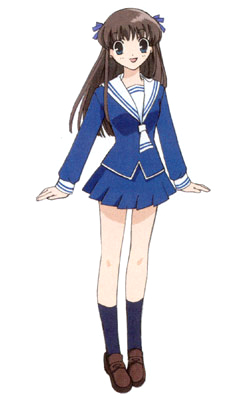

For examples of this phenomenon, I present to you a) Tohru from Fruits Basket and b) the titular character from House.
a) Fruits Basket
There's this trope called the Stepford Smiler where a character seems cheerful and all, but is really masking a deep-seated pain or crazy or whatever. The thing is, no one ever seems to see through it except the audience. The rest of the characters remain painfully oblivious until something happens that causes the mask to break.
Exhibit A: Torhu Honda
Just look at those big eyes and bright smile. So cute! She's kind, caring, unrelentingly cheerful...
But then she's so accommodating that she's practically a doormat, has deep-seated self-esteem issues (as does everyone in the show) and just generally has quite a few sucky moments in her past. Yet, the other characters would never have known if there weren't moments where she breaks down and says something she doesn't mean to. No one; not her friends, not her adoptive family, not even her real family. The audience sees it more than the other characters do, because we see her at her most vulnerable.
Contrast this to:
b) House M.D.
Exhibit B: Dr. Gregory House
Bitter, sarcastic, drug-riddled... He's a bit of a mess.
And everyone seems to know why. Patients he's only just met are monologuing at him, telling him all the reasons for why he acts the way he acts. Sure, sometimes he himself tells us about his past, but it's because people have been poking at him, prodding at him, explaining to him (and via him, the audience) why he acts the way he acts and how beneath his jerkish exterior there is a heart of gold.
I picked these two examples because they are particularly egregious. As mentioned, House's patients almost always seem to know exactly what his game is after just meeting him, and Tohru goes for a long, long time without anyone noticing that she was, oh, living in a tent, abused by her family, blah blah blah. In fact, she has to tell them mostly or have people see it for themselves. And the reverse is true in both examples as well: in early seasons of House M.D., no one seems to see how messed up Cameron is and all through Fruits Basket characters are explaining other character's issues to each other in response to bursts of temper.
And it always seems to be this way. If a character is a jerk, another character almost always has to insist that there is actually some sort of good in him and it will almost always turn out that there is. But if someone is indefatigably happy, it could be anything really hiding under the smile.
It's like characters (and I guess people in real life too) would like to think that when something seems all right, it is, but if something seems to be wrong, we have to pick at it until we find an answer.
Any other examples you guys can think of for either extreme? Or, conversely, any examples that completely defy these generalizations?
Wednesday, January 26, 2011
Not-so-happily ever after...
See, here's the thing: I write angst.
I don't want to. It's not like I mean to. But it seems like, because I take my characters so seriously, they start to take themselves too seriously and I end up with these serious stories, filled with psychological issues and just general not-fun.
It just sort of happens, even when I mean to write something a little more lighthearted. I mean, for NaNo10 even, I wrote a zombie story. How can you take a zombie story too seriously? The entire point of a zombie story is to have fun with it or scare the crap out of people. It's a survivor story and because there is no society, you have no rules and so you can go on a rampage of awesome.
But I had to bring character angst into it and it became one of my darker things to date, I think, simply because of the protagonists' lack of morals. It has a relatively happy ending, but still...
Then comes my hedgehog story. I meant for it to be light-hearted, sort of like Princess Tutu, which manages to make me smile every single episode, even when it descends into the dark and heart-wrenching. There is something just so heartwarming about it and funny and cute and just plain sweet, that manages to make the darker moments all the more dark. The ending is happy, if a little bittersweet, but it manages to still feel light and cheerful despite it all.
However, my projected ending for the hedgehog story (at least as it stands) is not really happy. If anything, it's bittersweet, with emphasis on the "bitter". There is a potential for a happy ending later, but the actual last event shown on the page would be heartbreaking (y'know, if I actually succeed in the correct mood in my writing).
The problem is that I can't think of a way to make a happy ending feel like a cop-out. After all I'm going to put my characters through and the world I have established, the happy ending I want wouldn't fit. It would feel like a deus ex machina, or just simply a saccharine ending. It would feel like I was forcing a happy ending on it.
It drives me crazy when stories do this, putting us through so much and then at the last minute pulling the ridiculously happy ending. And while it feels good the first time you experience it, the second time it doesn't feel quite the same. It can feel like a let-down, sort of negating all the suffering that came before it. I'd rather have it end with hope; maybe everything isn't perfect, but there is a knowledge that the future will improve and be happy.
That's sort of what I'm shooting for with my hedgehog story, but at the same time, it just sort of makes me super-aware of how angsty my stories seem to be all the time.
Quite angsty.
I don't want to. It's not like I mean to. But it seems like, because I take my characters so seriously, they start to take themselves too seriously and I end up with these serious stories, filled with psychological issues and just general not-fun.
It just sort of happens, even when I mean to write something a little more lighthearted. I mean, for NaNo10 even, I wrote a zombie story. How can you take a zombie story too seriously? The entire point of a zombie story is to have fun with it or scare the crap out of people. It's a survivor story and because there is no society, you have no rules and so you can go on a rampage of awesome.
But I had to bring character angst into it and it became one of my darker things to date, I think, simply because of the protagonists' lack of morals. It has a relatively happy ending, but still...
Then comes my hedgehog story. I meant for it to be light-hearted, sort of like Princess Tutu, which manages to make me smile every single episode, even when it descends into the dark and heart-wrenching. There is something just so heartwarming about it and funny and cute and just plain sweet, that manages to make the darker moments all the more dark. The ending is happy, if a little bittersweet, but it manages to still feel light and cheerful despite it all.
However, my projected ending for the hedgehog story (at least as it stands) is not really happy. If anything, it's bittersweet, with emphasis on the "bitter". There is a potential for a happy ending later, but the actual last event shown on the page would be heartbreaking (y'know, if I actually succeed in the correct mood in my writing).
The problem is that I can't think of a way to make a happy ending feel like a cop-out. After all I'm going to put my characters through and the world I have established, the happy ending I want wouldn't fit. It would feel like a deus ex machina, or just simply a saccharine ending. It would feel like I was forcing a happy ending on it.
It drives me crazy when stories do this, putting us through so much and then at the last minute pulling the ridiculously happy ending. And while it feels good the first time you experience it, the second time it doesn't feel quite the same. It can feel like a let-down, sort of negating all the suffering that came before it. I'd rather have it end with hope; maybe everything isn't perfect, but there is a knowledge that the future will improve and be happy.
That's sort of what I'm shooting for with my hedgehog story, but at the same time, it just sort of makes me super-aware of how angsty my stories seem to be all the time.
Quite angsty.
Monday, January 24, 2011
Devolution...
It's funny how ideas evolve. And sometimes devolve.
For real, my character of Rat is going through quite a lot of changes lately. She started out as sort of a bitter old man, unsatisfied with his lot in life. Then he turned into a bitter young man, a sort of incompetent student convinced he was more talented than he really was. Then he became a she, not even a student at all, but convinced that she was just as good as the men who were refusing to let her join them. Now she's sort of gone back to the original idea, becoming a bitter older woman, closer to the knight's age than she was, and unsatisfied with her lot in life, helping the knight and the hedgehog more out of boredom and to prove to her peers that she actually can, more than out of any real compassion.
It's strange how a character can go through stages of development like that, eventually coming full circle back to the original idea. It shows how sometimes you shouldn't second-guess yourself, or at least be willing to accept that the second-guess wasn't as good as the first idea.
Though, who's to say it won't change again? Ah, writing.
For real, my character of Rat is going through quite a lot of changes lately. She started out as sort of a bitter old man, unsatisfied with his lot in life. Then he turned into a bitter young man, a sort of incompetent student convinced he was more talented than he really was. Then he became a she, not even a student at all, but convinced that she was just as good as the men who were refusing to let her join them. Now she's sort of gone back to the original idea, becoming a bitter older woman, closer to the knight's age than she was, and unsatisfied with her lot in life, helping the knight and the hedgehog more out of boredom and to prove to her peers that she actually can, more than out of any real compassion.
It's strange how a character can go through stages of development like that, eventually coming full circle back to the original idea. It shows how sometimes you shouldn't second-guess yourself, or at least be willing to accept that the second-guess wasn't as good as the first idea.
Though, who's to say it won't change again? Ah, writing.
Friday, January 21, 2011
Predestination…
It’s part of the reason why my angel project was dropped, or at least shelved. I was trying to force two characters into a particular relationship and it just wasn’t working. It didn’t make sense for their personalities as they evolved.
In my current hedgehog project, I sort of wanted Rat to end up with a crush on the knight, but the way it’s going right now, she would have to be a real masochist for that to work. I mean, he’s been downright nasty to her. Not just the antagonistic “jerk with a heart of gold” or anything, but almost genuinely abusive. She brought a lot of it on herself (y’know, scaring him half to death, hurting the only thing that’s giving him meaning in life, “stealing” said creature and disappearing) but for her to end up with a crush on him, there is either something really wrong with her (which, the more I write her, the more I am suspecting) or there is going to have to be some serious character development for both of them.
Which is going to happen in either case, but whether it will turn out the way I initially wanted is up in the air. Yay?
Have you guys ever had a character relationship not turn out the way you planned it, or emerge out of nowhere? Do you know how your characters are going to respond to each other or is it just “wait and see” for you?
Saturday, January 15, 2011
I hate it when they disappoint me like this...
Darn you, muse, and your easily-distracted tendencies!
So, last night, I watched Titan A.E. for the first time and was both a) pleasantly surprised and b) bitterly disappointed.
a) The Happy
- It was a gritty, lived-in, rag-tag sci-fi, one of my favorite types of the genre. I love the idea of very different crew members on a small ship interacting and getting along (or not). (Funny anecdote: I kept being reminded of Firefly through the movie, just in little bits and pieces, only to find out that Joss Whedon had been one of the screenwriters. Lulz for perception.)
- The voice cast was surprisingly star-studded. My especial fangirl moment was when I found out Cale's dad's voice (which I had actually commented on when he first started talking) is Ron Perlman. It made me happy.
- It was actually rather adult in tone. Not "adult" adult, but very mature. And quite dark. I mean, there are character deaths on screen, a few rather gruesome. It was nice to see a Western animation that wasn't really for kids and wasn't something like Family Guy or South Park.
- The music was pretty cool, especially the first real rock song that that shows up as Cale is working his dead-beat job.
b) The Sad
- Mostly just missed potential. There were some great set-ups for characters. Cale, the cocky, cynical, "cute but troubled" guy with daddy issues, the well-educated and grumpy weapons expert Stith, the creepily charming Preed (who, btw, was my favorite of everyone we got to see for however short a time). All with huge potential for interaction and unique development that went nowhere. We barely get to see them acting in these characterizations before they're pretty much forgotten about and they are just vehicles for the lines that need to be said in order to get the story moving. The romance between Cale and Akima felt so forced, when it really could have been great, with her teaching him to hope again and stuff. I dunno, it just felt like they were shooting for so much more and it felt completely on its face.
- I wasn't too clear on the motivations behind the characters at all, aside from perhaps Akima and only her because she insisted on making a speech about it every time she and Cale were alone on screen.
- The animation sometimes didn't seem like it knew whether it was shooting for realistic or cartoony. It threw me off a few times.
All in all, it wasn't the worst movie I'd ever seen, but I wouldn't even say it was that good by a long shot. Apparently, it came out at the same time as Treasure Planet and is actually surprisingly (though just superficially) similar to the other movie. But Treasure Planet handled itself better, making it about the characters before it was about the quest. And it's a stronger movie for it, one that actually makes me cry during some scenes, despite its annoying sidekick characters.
But, despite Titan A.E.'s less-than-thrilling review from me... I want to watch it again. It's like it had so much wasted potential that it drives me up the wall and I want to watch it again to find some sort of redeeming qualities in it. I do this with Tim Burton's Alice in Wonderland too. That was another movie with so much potential that it just never lives up to. But I want to watch it again, to pick it apart, to try to find something that would let me like it.
Plus, my muse is going nuts after sampling such potential and the parts of my brain that were chugging along after Pitch Black are starting back up again. Gah. And I actually like where I am in my hedgehog story too...
So, last night, I watched Titan A.E. for the first time and was both a) pleasantly surprised and b) bitterly disappointed.
a) The Happy
- It was a gritty, lived-in, rag-tag sci-fi, one of my favorite types of the genre. I love the idea of very different crew members on a small ship interacting and getting along (or not). (Funny anecdote: I kept being reminded of Firefly through the movie, just in little bits and pieces, only to find out that Joss Whedon had been one of the screenwriters. Lulz for perception.)
- The voice cast was surprisingly star-studded. My especial fangirl moment was when I found out Cale's dad's voice (which I had actually commented on when he first started talking) is Ron Perlman. It made me happy.
- It was actually rather adult in tone. Not "adult" adult, but very mature. And quite dark. I mean, there are character deaths on screen, a few rather gruesome. It was nice to see a Western animation that wasn't really for kids and wasn't something like Family Guy or South Park.
- The music was pretty cool, especially the first real rock song that that shows up as Cale is working his dead-beat job.
b) The Sad
- Mostly just missed potential. There were some great set-ups for characters. Cale, the cocky, cynical, "cute but troubled" guy with daddy issues, the well-educated and grumpy weapons expert Stith, the creepily charming Preed (who, btw, was my favorite of everyone we got to see for however short a time). All with huge potential for interaction and unique development that went nowhere. We barely get to see them acting in these characterizations before they're pretty much forgotten about and they are just vehicles for the lines that need to be said in order to get the story moving. The romance between Cale and Akima felt so forced, when it really could have been great, with her teaching him to hope again and stuff. I dunno, it just felt like they were shooting for so much more and it felt completely on its face.
- I wasn't too clear on the motivations behind the characters at all, aside from perhaps Akima and only her because she insisted on making a speech about it every time she and Cale were alone on screen.
- The animation sometimes didn't seem like it knew whether it was shooting for realistic or cartoony. It threw me off a few times.
All in all, it wasn't the worst movie I'd ever seen, but I wouldn't even say it was that good by a long shot. Apparently, it came out at the same time as Treasure Planet and is actually surprisingly (though just superficially) similar to the other movie. But Treasure Planet handled itself better, making it about the characters before it was about the quest. And it's a stronger movie for it, one that actually makes me cry during some scenes, despite its annoying sidekick characters.
But, despite Titan A.E.'s less-than-thrilling review from me... I want to watch it again. It's like it had so much wasted potential that it drives me up the wall and I want to watch it again to find some sort of redeeming qualities in it. I do this with Tim Burton's Alice in Wonderland too. That was another movie with so much potential that it just never lives up to. But I want to watch it again, to pick it apart, to try to find something that would let me like it.
Plus, my muse is going nuts after sampling such potential and the parts of my brain that were chugging along after Pitch Black are starting back up again. Gah. And I actually like where I am in my hedgehog story too...
Tuesday, January 11, 2011
We're different, different as can be...
Yay for super-mega-foxy-awesome-hot fan-produced parody musicals and their ability to inspire blog titles.
---
It's funny, how even when you know something, it doesn't really sink in. This past November, I finally sort of got it through my head that my characters don't have to think the same way I do.
It's not that I was opposed to the thought of people having different thoughts than me, I just didn't really write characters that were all that different from my own way of thinking (excepting perhaps the antagonists). However, for NaNoWriMo last year, nearly every single one of my protagonists thought quite differently from me. They approached problems differently than me, they resolved issues differently than I would, and they were just different people.
Not that (I hope) all of my characters have been the same before this, but this was where I noticed a real change from myself. And, just like the narrative style, I'm ripping off what worked from that novel for my hedgehog story. In this case, writing outside my comfort zone.
My narrator isn't much like me at all. In fact, I find myself annoyed by her sometimes. But that's part of her character and she'll grow out of some of the more universally-annoying traits, though I don't think she'll ever come into conformity with how I think. And I don't want her to. It's a new experience for me as a writer. I like it.
---
It's funny, how even when you know something, it doesn't really sink in. This past November, I finally sort of got it through my head that my characters don't have to think the same way I do.
It's not that I was opposed to the thought of people having different thoughts than me, I just didn't really write characters that were all that different from my own way of thinking (excepting perhaps the antagonists). However, for NaNoWriMo last year, nearly every single one of my protagonists thought quite differently from me. They approached problems differently than me, they resolved issues differently than I would, and they were just different people.
Not that (I hope) all of my characters have been the same before this, but this was where I noticed a real change from myself. And, just like the narrative style, I'm ripping off what worked from that novel for my hedgehog story. In this case, writing outside my comfort zone.
My narrator isn't much like me at all. In fact, I find myself annoyed by her sometimes. But that's part of her character and she'll grow out of some of the more universally-annoying traits, though I don't think she'll ever come into conformity with how I think. And I don't want her to. It's a new experience for me as a writer. I like it.
Saturday, January 8, 2011
Motivation...
Motivation.
It's key for characters. You get a couple good characters, give them some motivation, and throw them in a setting and plot will happen like crazy. I've always been far more character-oriented than plot-oriented, just because plot comes from characters, so you just worry about the one and the other follows.
But motivation takes some exploration to find. Right now, I'm still finding my characters' motivation. It's how I write. I just sort of stick characters together, let them interact, let them blather on about unimportant stuff, until I find something, anything that's important to them. You get those one or two things and make that character work for it. And it can change. It often does.
It's why my first drafts are so messy. I mean, it's said that you will cut out the first three chapters of your first draft. It's certainly true for me, since that's when I just sort of hash around and mess with everything. I never know what I'm doing going in. The first half of my NaNo is seriously just me poking things and seeing what jiggles.
So right now, I'm playing with the idea of motivation for my characters. My narrator is just sort of complaining right now, but I have an idea for future motivation for her. But as for my knight and his hedgehog, I'm sort of kicking around layers of motivation. I mean, the hedgehog wants to become a princess. However, that's not enough.
To continue my references to Princess Tutu, (I just rewatched it this weekend), there are several layers of motivation. It starts out simple: Ahiru wants to save Mytho. Everything she ever does is in pursuit of that goal. But as she continues to work towards that goal, she accumulates more goals. She wants to remain a girl. She wants to be with the people she loves. She wants so much more than just to save Mytho, even if that is her primary motivation. It comes down to the point where she isn't even sure if that, her original goal, is still want she wants anymore.
Plot unfolds from that.
So I guess I'll just be hashing around for a while, putting down as much blahsome as much as possible. The editing will come later, actually sorting through it all to find the awesome (or least sucky) hidden in there.
It's key for characters. You get a couple good characters, give them some motivation, and throw them in a setting and plot will happen like crazy. I've always been far more character-oriented than plot-oriented, just because plot comes from characters, so you just worry about the one and the other follows.
But motivation takes some exploration to find. Right now, I'm still finding my characters' motivation. It's how I write. I just sort of stick characters together, let them interact, let them blather on about unimportant stuff, until I find something, anything that's important to them. You get those one or two things and make that character work for it. And it can change. It often does.
It's why my first drafts are so messy. I mean, it's said that you will cut out the first three chapters of your first draft. It's certainly true for me, since that's when I just sort of hash around and mess with everything. I never know what I'm doing going in. The first half of my NaNo is seriously just me poking things and seeing what jiggles.
So right now, I'm playing with the idea of motivation for my characters. My narrator is just sort of complaining right now, but I have an idea for future motivation for her. But as for my knight and his hedgehog, I'm sort of kicking around layers of motivation. I mean, the hedgehog wants to become a princess. However, that's not enough.
To continue my references to Princess Tutu, (I just rewatched it this weekend), there are several layers of motivation. It starts out simple: Ahiru wants to save Mytho. Everything she ever does is in pursuit of that goal. But as she continues to work towards that goal, she accumulates more goals. She wants to remain a girl. She wants to be with the people she loves. She wants so much more than just to save Mytho, even if that is her primary motivation. It comes down to the point where she isn't even sure if that, her original goal, is still want she wants anymore.
Plot unfolds from that.
So I guess I'll just be hashing around for a while, putting down as much blahsome as much as possible. The editing will come later, actually sorting through it all to find the awesome (or least sucky) hidden in there.
Monday, January 3, 2011
Somehow, it all works out...
Strange how I can spend so much time trying to think of character motivation and development and arcs and whatnot and not actually write a word, then just sort of come up with a change and let the characters run with it and end up with stuff that is a million times better.
So, there was this magician character I had planned for my hedgehog story. He was originally a guy. But what if I was to make him a girl? Suddenly, there is a great deal more opportunity for growth than there was before, just by changing the dynamics that will automatically arise from her interactions with the rest of the characters.
Yeah, yet another glowing example of how much of a pantser I am, that I literally do much better when completely winging it than when I try to outline/plan/develop the story beforehand.
Tomorrow, I vow to begin writing.
So, there was this magician character I had planned for my hedgehog story. He was originally a guy. But what if I was to make him a girl? Suddenly, there is a great deal more opportunity for growth than there was before, just by changing the dynamics that will automatically arise from her interactions with the rest of the characters.
Yeah, yet another glowing example of how much of a pantser I am, that I literally do much better when completely winging it than when I try to outline/plan/develop the story beforehand.
Tomorrow, I vow to begin writing.
Wednesday, December 15, 2010
Don't go away...
December 15 – 5 Minutes Imagine you will completely lose your memory of 2010 in five minutes. Set an alarm for five minutes and capture the things you most want to remember about 2010.Not all writing-related here. Five minutes and go!
---
Everyone remembering my birthday because my brother told all of YWS about it. Multiple phone calls from friends and a surprise party thrown by said brother.
Creative writing class and the kooky antics therein (Cujo, duct tape as the key to meaning).
Riverby books.
Job interview with Percy the Corgi-mix.
First day at work.
Soup (broccoli and cheddar).
My grandpa holding out until 2 am on January 26th. Thanks, Grandpa, for waiting, selfish as that "thank you" is. You were an awesome grandparent.
Volleyball coaching and our two wins in the last two games (kinda sad that they were both against the same team).
Princess Tutu.
NaNo and the wonderful write-ins.
Newseum and White Sox.
Live violin outside the school.
The other dude running the red light and smashing my bumper. Then, a few weeks after fixing said bumper, I back the car into the tractor.
Writing, writing and more writing.
---
Yeah, I feel like I should have been able to remember more. The trouble is, a lot of the moments I want to remember happened in '09 and I keep thinking they were this year. 2010 went quickly when I think about it. A lot of wonderful moments that were rather like the moments before them. Picking out the special ones, trying to decide which rise above the others, is not fun and unfair to all the other perfectly mundane but perfectly wonderful moments. I want to remember the whole year, not just these little snippets.
This prompt actually depresses me, the more I seriously consider losing my entire memory of 2010. There's a lot of memory, a lot of shaping, a lot of ME that would be lost. It's just a sum movement rather than individual spurts.
Wednesday, November 17, 2010
When in doubt...
...give your character a mental illness. Which gives us a segue into the catch-up memes:

I think Virginia is going to turn out to be crazy-nuts, based on her traumatic experiences. Most of her backstory is a hallucination and the resolution of the story is now going to be about trying to save her from herself and Bluejay, rather than trying to heal the zombie-fied children. Because there wasn't a way to save the zombie-fied children.
Still behind, but feeling good now that I have a slightly more definite resolution in mind. Still gotta figure out how Ian's going to play back in, but we'll see if he redeems himself or not.
Day 15 - Do any of your characters have a disability or mental illness? If so, how does that affect their development throughout your story?If I had actually done this particular meme entry on the actual day 15 of NaNo, the answer would have been "no" (well, maybe the zombies, but there's a lot wrong with them), but today, that all changed.
I think Virginia is going to turn out to be crazy-nuts, based on her traumatic experiences. Most of her backstory is a hallucination and the resolution of the story is now going to be about trying to save her from herself and Bluejay, rather than trying to heal the zombie-fied children. Because there wasn't a way to save the zombie-fied children.
Day 16 - At around the half-way point, it bears mentioning that most of us wrimos have other obligations beside simply hitting that elusive word count. What else do you have going on in your life (work, school, children, neurotic pets, etc.), and just how much are you shafting it to win NaNo?School, work, sleep. Sleep is getting a shorter end of the stick, but mostly it's been NaNo losing out this year.
Day 17 - In what time period is your novel set? Is it in this world or another?Eh, I'd say a slightly alternate version of this world (y'know, to accommodate the fairies) somewhere in the future, after some sort of world-wide near-apocalypse.
Still behind, but feeling good now that I have a slightly more definite resolution in mind. Still gotta figure out how Ian's going to play back in, but we'll see if he redeems himself or not.
Saturday, October 16, 2010
Subtlety...
Okay, writers who want "strong females"; if part of your female character's characterization is that she doesn't need a man to complete her, do not, repeat do not, state as much when describing said character.
For example:
That is not the way to do it, m'friends. It makes the character sound bitter.
Now, if the character is bitter, this works. But the thing is, if you are trying to make a female character who literally can stand on her own two feet as a person, you fail. By basing her personhood on the fact that she doesn't need a man, you have just made her characterization all about the man that she "doesn't need".
It depends on the character that you are trying to portray, but too often, this is used with the intent of creating a "strong female character". Then, nine times out of ten, this character then runs into a man who then does everything for her. But we are supposed to believe that this female character is strong, because we were told she doesn't need a man.
Instead, the way to handle a female character who "doesn't need a man" is just to have her functioning without a man. No need to draw attention to it. Just have it happen.
Needing or not needing a man to "complete" a character are not necessarily good or bad things. It all depends on how they are handled.The influence of a male character on the female character doesn't necessarily mean she is "weak" or "underdeveloped" and likewise, a lack of male influence on a female character doesn't necessarily mean she is "strong" or "independent".
Basically, it all comes down to treating the characters, both male and female, as people.
For example:
Maria hadn't had a boyfriend in three years. Too much of a hassle.
That is not the way to do it, m'friends. It makes the character sound bitter.
Now, if the character is bitter, this works. But the thing is, if you are trying to make a female character who literally can stand on her own two feet as a person, you fail. By basing her personhood on the fact that she doesn't need a man, you have just made her characterization all about the man that she "doesn't need".
It depends on the character that you are trying to portray, but too often, this is used with the intent of creating a "strong female character". Then, nine times out of ten, this character then runs into a man who then does everything for her. But we are supposed to believe that this female character is strong, because we were told she doesn't need a man.
Instead, the way to handle a female character who "doesn't need a man" is just to have her functioning without a man. No need to draw attention to it. Just have it happen.
Needing or not needing a man to "complete" a character are not necessarily good or bad things. It all depends on how they are handled.The influence of a male character on the female character doesn't necessarily mean she is "weak" or "underdeveloped" and likewise, a lack of male influence on a female character doesn't necessarily mean she is "strong" or "independent".
Basically, it all comes down to treating the characters, both male and female, as people.
Saturday, September 11, 2010
"Getting to know you"...
I'm currently taking a creative writing class because I'd never taken one before and was curious to see what they were like. My current conclusion is that no one can teach you how to write. Sure, they can give you pointers and you can use other people's techniques and follow their advice, but you will only ever learn from yourself really. I got where I am today by writing and while I'm nowhere near perfect, I'm comfortable enough with my writing that I can hear advice and then promptly either ignore it or adapt it for my own purposes.
For instance, we were recently talking about characters and getting to know them. I've read before about character sheets and while I can't deny that I've ever used them, I've never found them helpful. Many, many, many writing "how-to"s will tell you to get to know your characters inside out. Write down all their likes and dislikes, their relationships with their family, everything about them, even if that information never makes it into the story.
Personally, I find that sort of thing to be rather pointless.
Getting to know your characters is vital, sure. It's important to know what your character feels about things. However, I've never been one to outline and so very often, my method for character development is to take a character and throw them into the situation in my story and see what they do. Every character I've written that I can think of in recent memory has been written like this. My latest creations would be Bluejay and Suli from my as-of-yet unofficially titled "Bluejay Project".
I started off with basic archetypes in mind. Basically, Bluejay was fae and Suli was a plucky young heroine. Then I threw other characters in alongside them and they began to flesh out. It turns out Suli many more insecurities than I would have ever thought up just "character planning" and Bluejay is really good at avoiding the blame for things.
Plot arises from my characters' developments. I often have a vague idea about where I want the story to end up, but how they get there is often completely up in the air. Bluejay not always getting what he wants and Suli coming to grips with herself are now going to play big roles in my projected ending. I already had something like that in mind, but actually having developed the characters enough to do so, it feels so much better.
My writing style makes for a really messy first draft, but it is a first draft filled with great discovery. Even I don't know what's going to happen sometimes. It's like reading a story for the first time, except I'm the one writing. it.
For instance, we were recently talking about characters and getting to know them. I've read before about character sheets and while I can't deny that I've ever used them, I've never found them helpful. Many, many, many writing "how-to"s will tell you to get to know your characters inside out. Write down all their likes and dislikes, their relationships with their family, everything about them, even if that information never makes it into the story.
Personally, I find that sort of thing to be rather pointless.
Getting to know your characters is vital, sure. It's important to know what your character feels about things. However, I've never been one to outline and so very often, my method for character development is to take a character and throw them into the situation in my story and see what they do. Every character I've written that I can think of in recent memory has been written like this. My latest creations would be Bluejay and Suli from my as-of-yet unofficially titled "Bluejay Project".
I started off with basic archetypes in mind. Basically, Bluejay was fae and Suli was a plucky young heroine. Then I threw other characters in alongside them and they began to flesh out. It turns out Suli many more insecurities than I would have ever thought up just "character planning" and Bluejay is really good at avoiding the blame for things.
Plot arises from my characters' developments. I often have a vague idea about where I want the story to end up, but how they get there is often completely up in the air. Bluejay not always getting what he wants and Suli coming to grips with herself are now going to play big roles in my projected ending. I already had something like that in mind, but actually having developed the characters enough to do so, it feels so much better.
My writing style makes for a really messy first draft, but it is a first draft filled with great discovery. Even I don't know what's going to happen sometimes. It's like reading a story for the first time, except I'm the one writing. it.
Wednesday, August 25, 2010
Attack of the Genre Fiction...
So I'm taking a creative writing class this semester at college. I've always wanted to take one and it fulfills one of my needed credits, so I'm happy as a clam right now.
My first class was the typical "run-down of the syllabus/icebreaker session" that all first classes are, and my professor said that we wouldn't be getting to genre fiction until the end and until then we would be focused just on the craft of writing. This got me thinking about genre fiction in general.
I would say that I have typically written within in a particular genre. I tend to put my writing under the labels of "fantasy" or "sci-fi", with some "action/adventure" perhaps thrown in. However, I wouldn't necessarily say that I am a "genre writer".
I like genres. They give me an idea of what I am in for in a novel/story. It's the reason "general/other" fiction daunts me so much, because there is so much that could encompass. I've done some forays into that idea of "general" fiction, but I'll admit to clinging a bit to the comfort of genres.
However, when I write, I tend to use the genre more as a framing device than as a definition of my story. It's part of the reason my NaNo novel of '08 is tentatively classified as "fantasy", with more emphasis on "action/adventure" or something. I mean, it has no fantastical elements beyond being set in a world entirely of my own creation. I wouldn't say it follows a typical "fantasy" storyline at all, being more about the trials and tribulations of two characters in a rather fantastical setting.
There are probably certainly exceptions to everything I am saying, but it seems like many genres tend to follow a particular formula. If you read any "how-to" book on a particular genre, there will be certain things that they tell you to do that "define" the genre. They work a certain way. Sure, you can play with them a bit, but ultimately, they don't get stretched all that far. It's why something that really shakes things up is so recognized and hailed as revolutionary. Thing is, that becomes the norm and then we are back to a status quo within genres.
I have trouble with genres in my own writing for this reason. I mean, sure, I once wrote a "typical" fantasy story when I was younger (complete with "girl going to magic world", "mysterious swordsman" and "artifact of doom"), but nowadays, I (hopefully) deal more with characters than plots. I wanna write stories that might fall within a particular genre, but sort of blur lines with "real life" stories in how I handle my characters. I want them to have to deal with the little things too, as much as they have to deal with saving the world/stopping the big bad/finding true love. I want genuine character interaction beyond "I am your father/I'm in love with you/You betrayed me". I like using a genre as just sort of a playground, to put a reader on familiar ground, then to get into more meaningful interaction that just escapism.
Now, I'm definitely not original in this idea and I've read some great fiction that reads like this (trying to remember the title, but the one that immediately jumps to mind was a mystery novel that was more of a story about a character with brain cancer and how his life was affected... the mystery just happened to happen in the middle of it).
I'm probably being super-general and unfair to a lot of fabulous novels. I do actually enjoy the conventions of genre writing sometimes. I'm just trying to figure out my own style and how I can try to break conventions a bit.
My first class was the typical "run-down of the syllabus/icebreaker session" that all first classes are, and my professor said that we wouldn't be getting to genre fiction until the end and until then we would be focused just on the craft of writing. This got me thinking about genre fiction in general.
I would say that I have typically written within in a particular genre. I tend to put my writing under the labels of "fantasy" or "sci-fi", with some "action/adventure" perhaps thrown in. However, I wouldn't necessarily say that I am a "genre writer".
I like genres. They give me an idea of what I am in for in a novel/story. It's the reason "general/other" fiction daunts me so much, because there is so much that could encompass. I've done some forays into that idea of "general" fiction, but I'll admit to clinging a bit to the comfort of genres.
However, when I write, I tend to use the genre more as a framing device than as a definition of my story. It's part of the reason my NaNo novel of '08 is tentatively classified as "fantasy", with more emphasis on "action/adventure" or something. I mean, it has no fantastical elements beyond being set in a world entirely of my own creation. I wouldn't say it follows a typical "fantasy" storyline at all, being more about the trials and tribulations of two characters in a rather fantastical setting.
There are probably certainly exceptions to everything I am saying, but it seems like many genres tend to follow a particular formula. If you read any "how-to" book on a particular genre, there will be certain things that they tell you to do that "define" the genre. They work a certain way. Sure, you can play with them a bit, but ultimately, they don't get stretched all that far. It's why something that really shakes things up is so recognized and hailed as revolutionary. Thing is, that becomes the norm and then we are back to a status quo within genres.
I have trouble with genres in my own writing for this reason. I mean, sure, I once wrote a "typical" fantasy story when I was younger (complete with "girl going to magic world", "mysterious swordsman" and "artifact of doom"), but nowadays, I (hopefully) deal more with characters than plots. I wanna write stories that might fall within a particular genre, but sort of blur lines with "real life" stories in how I handle my characters. I want them to have to deal with the little things too, as much as they have to deal with saving the world/stopping the big bad/finding true love. I want genuine character interaction beyond "I am your father/I'm in love with you/You betrayed me". I like using a genre as just sort of a playground, to put a reader on familiar ground, then to get into more meaningful interaction that just escapism.
Now, I'm definitely not original in this idea and I've read some great fiction that reads like this (trying to remember the title, but the one that immediately jumps to mind was a mystery novel that was more of a story about a character with brain cancer and how his life was affected... the mystery just happened to happen in the middle of it).
I'm probably being super-general and unfair to a lot of fabulous novels. I do actually enjoy the conventions of genre writing sometimes. I'm just trying to figure out my own style and how I can try to break conventions a bit.
Sunday, August 22, 2010
A problem...
I think I found one of the reasons I'm having such trouble with my current project.
I've lost focus of a central conflict.
The story was originally a deconstruction of the idea of the supernatural boyfriend and how that sort of situation could very easily go wrong. It was all about a girl and dealing with an abusive relationship that is still abusive for all of its "speshulness". It was about overcoming fear and distrust and learning to move on with your life.
Problem was, I realized just how stupid my main character was and I tried to rectify that by adding another character to the mix rather than just accept that a particular relationship was the thing going wrong and maybe that I didn't need that relationship.
The thing with my story now is that I don't have a central conflict. With Laura as the main character, sure that one relationship with Clark didn't work out, but at least I had a conflict. I just needed to think of another way to resolve it. With Melody, Laura is still a player with her relationship with Gabriel and that conflict is there, but it becomes secondary. And so I've lost a central theme, because Melody has no conflict. She's there to help Laura solve her problem and to be there for Clark. Suddenly, the story has no point of interest and that's why I'm having trouble with it. There's no conflict. I lost it somewhere along the line.
So I have a few options:
a) Go back to my original idea, cut what wasn't working and expand what was. Originally, this thing was supposed to be a short story and I think it might just have to turn back into one or perhaps some sort of novella. I don't really see it in its original form as a novel.
b) Figure out some sort of conflict that would make Melody's story fit into Laura's somehow. The problem with this is that I'm losing Laura's story, which was the original story I wanted to tell.
All in all, I think this is something I'm going to shelve for a little while so I can ponder it and not feel freaked out that I'm not working on it. I might figure something out, I might not. I'm just going to let it sit for right now. I like the characters and I want to do something with them, so if they end up repurposed somewhere else, so be it.
I'm not going to let it get to me anymore.
I've lost focus of a central conflict.
The story was originally a deconstruction of the idea of the supernatural boyfriend and how that sort of situation could very easily go wrong. It was all about a girl and dealing with an abusive relationship that is still abusive for all of its "speshulness". It was about overcoming fear and distrust and learning to move on with your life.
Problem was, I realized just how stupid my main character was and I tried to rectify that by adding another character to the mix rather than just accept that a particular relationship was the thing going wrong and maybe that I didn't need that relationship.
The thing with my story now is that I don't have a central conflict. With Laura as the main character, sure that one relationship with Clark didn't work out, but at least I had a conflict. I just needed to think of another way to resolve it. With Melody, Laura is still a player with her relationship with Gabriel and that conflict is there, but it becomes secondary. And so I've lost a central theme, because Melody has no conflict. She's there to help Laura solve her problem and to be there for Clark. Suddenly, the story has no point of interest and that's why I'm having trouble with it. There's no conflict. I lost it somewhere along the line.
So I have a few options:
a) Go back to my original idea, cut what wasn't working and expand what was. Originally, this thing was supposed to be a short story and I think it might just have to turn back into one or perhaps some sort of novella. I don't really see it in its original form as a novel.
b) Figure out some sort of conflict that would make Melody's story fit into Laura's somehow. The problem with this is that I'm losing Laura's story, which was the original story I wanted to tell.
All in all, I think this is something I'm going to shelve for a little while so I can ponder it and not feel freaked out that I'm not working on it. I might figure something out, I might not. I'm just going to let it sit for right now. I like the characters and I want to do something with them, so if they end up repurposed somewhere else, so be it.
I'm not going to let it get to me anymore.
Tuesday, July 20, 2010
Rethinking...
Rambling to myself mostly. Sometimes just writing out a problem and potential solutions really helps work through the problem. 'Tis called "brainstorming", methinks.
It might just be me, but would you believe it's possible to write two characters who you intended from the start to be together, but who, the way they have grown and developed, might not be right for each other at all?
Clark and Laura have always been the romantic couple of my project. They were intended to be so from the beginning. The whole story I intended to tell sort of hinged on it.
Thing is, Laura is pretty much useless in the story as it stands right now. She just... is. And just... being and not actively kicking anything off makes for a pretty boring character. She doesn't do anything: stuff happens to her.
After having realized this, I thought about what I could do to make her more proactive. I thought about making her actually romantically involved with Gabriel, my angel-man. Originally, I didn't want them involved because then she would just have been jumping ship from Gabriel to Clark, a complete one-eighty, at the drop of a hat and who likes a character like that? Not me.
So I thought maybe I could actually have her being in on Gabriel's schemes and whatnot. Right now, she is innocent of anything beyond harboring a fugitive (who she didn't really know was a fugitive). So what if I made it so that she really did know about it and was actively hiding it from Clark?
There are two problems with this:
1) Then why would she give up on Gabriel like she is supposed to? (Seeing as how my original intent was a deconstruction of the monster boyfriend trope.)
2) Clark is not the sort to fall for the enemy. I know, forbidden fruit and all that and there's the whole "good guy brings the bad girl to the light" or something, but that's not Clark. The femme fatale holds no attraction for him.
So, what does this mean? Well, the way she is right now (completely useless), I refuse to reward Laura with a relationship with an imminently more useful guy. I mean, she doesn't deserve it and he has no reason to fall for her anyway.
The way I see it, I have several options.
1) Give up and cry about what a sucky excuse I am for a writer. ("Outline? Planning? We have not these words in my country.")
2) Have Clark and Laura's relationship not be romantic in any way (because it seems like no matter what I do for Laura's development, it drives them apart).
or
3) Rethink my characters a bit. As I was typing this all out, I had the crazy idea of removing Laura as my main character and instead try out another female character as my viewpoint character. Maybe a policewoman or something. I want it to be a female because it seems like lately all my interesting characters have been male and I want to see if that's just a fluke. Plus, it would allow her to sympathize with Laura's situation a bit more, methinks.
(Now I have a whole rant I want to do on female characters - based on an essay on writing female PI characters I read recently.)
The only thing is that reworking the characters like that would have me lose some of my more favorite moments I already had in mind. However, it does open the door for some other situations, such as actual legitimate reasons for Clark and whoever to be together in some scenarios, where before it was difficult keeping track of both Clark and Laura's stories because they were apart so often.
Hmm, I'm almost afraid to say that I have finally worked this out (seeing as how I had thought that before and this is what came of it), but this has me more excited about this whole thing than I have been in a while.
It might just be me, but would you believe it's possible to write two characters who you intended from the start to be together, but who, the way they have grown and developed, might not be right for each other at all?
Clark and Laura have always been the romantic couple of my project. They were intended to be so from the beginning. The whole story I intended to tell sort of hinged on it.
Thing is, Laura is pretty much useless in the story as it stands right now. She just... is. And just... being and not actively kicking anything off makes for a pretty boring character. She doesn't do anything: stuff happens to her.
After having realized this, I thought about what I could do to make her more proactive. I thought about making her actually romantically involved with Gabriel, my angel-man. Originally, I didn't want them involved because then she would just have been jumping ship from Gabriel to Clark, a complete one-eighty, at the drop of a hat and who likes a character like that? Not me.
So I thought maybe I could actually have her being in on Gabriel's schemes and whatnot. Right now, she is innocent of anything beyond harboring a fugitive (who she didn't really know was a fugitive). So what if I made it so that she really did know about it and was actively hiding it from Clark?
There are two problems with this:
1) Then why would she give up on Gabriel like she is supposed to? (Seeing as how my original intent was a deconstruction of the monster boyfriend trope.)
2) Clark is not the sort to fall for the enemy. I know, forbidden fruit and all that and there's the whole "good guy brings the bad girl to the light" or something, but that's not Clark. The femme fatale holds no attraction for him.
So, what does this mean? Well, the way she is right now (completely useless), I refuse to reward Laura with a relationship with an imminently more useful guy. I mean, she doesn't deserve it and he has no reason to fall for her anyway.
The way I see it, I have several options.
1) Give up and cry about what a sucky excuse I am for a writer. ("Outline? Planning? We have not these words in my country.")
2) Have Clark and Laura's relationship not be romantic in any way (because it seems like no matter what I do for Laura's development, it drives them apart).
or
3) Rethink my characters a bit. As I was typing this all out, I had the crazy idea of removing Laura as my main character and instead try out another female character as my viewpoint character. Maybe a policewoman or something. I want it to be a female because it seems like lately all my interesting characters have been male and I want to see if that's just a fluke. Plus, it would allow her to sympathize with Laura's situation a bit more, methinks.
(Now I have a whole rant I want to do on female characters - based on an essay on writing female PI characters I read recently.)
The only thing is that reworking the characters like that would have me lose some of my more favorite moments I already had in mind. However, it does open the door for some other situations, such as actual legitimate reasons for Clark and whoever to be together in some scenarios, where before it was difficult keeping track of both Clark and Laura's stories because they were apart so often.
Hmm, I'm almost afraid to say that I have finally worked this out (seeing as how I had thought that before and this is what came of it), but this has me more excited about this whole thing than I have been in a while.
Subscribe to:
Posts (Atom)